


Solitaire Town Tycoon
4.61.26K Reviews
App Specs
- Version
- 13.9.0
- Updated On
- License
- Free
- Downloads
- 100,000+
- Developer
- Casual Skill Games
- Categories
- Card
- Platform
- Android
Screenshots

 Analysis by AppCompare
Solitaire Town Tycoon is the kind of card game I open when I want something familiar but still need a reason to keep playing. Its foundation is classic solitaire, yet the presentation is built around the idea of moving through a larger game world rather than simply clearing one deal after another. That difference matters: the cards remain easy to understand, while the surrounding goals give each session a little more purpose.
I found it most appealing in short, repeatable sessions. It works well when I have a few quiet minutes and do not want to learn a complicated ruleset. At the same time, the reward-focused design means it is not just a completely relaxed solitaire table. There is a stronger sense of pursuit, and that can be motivating for some players while feeling like pressure to others.
Developed by Casual Skill Games, this free card game is aimed at mature players and carries a 17+ content rating. It was released on August 5, 2025, and version 13.9.0 is the version I would look for when checking compatibility. The game requires iOS or Android 12 or later, so anyone using an older phone or tablet should check that first.
How Solitaire Town Tycoon Turns Familiar Cards Into a Longer Goal
I like how Solitaire Town Tycoon gives familiar solitaire a longer arc, but a shared phone or tablet changes how I would approach that appeal. In this section, I’m looking at what happens when one person’s quick card session sits alongside other people’s routines, and why keeping the game’s goals distinct from household expectations matters. That leads naturally to the practical question of who should handle setup and spending decisions.
The first goals are clear, even if the broader journey takes time
The opening appeal is straightforward: I already know how solitaire works, so I can concentrate on the immediate objective instead of learning a new card game. That low barrier is important. A complicated strategy game may ask me to remember several systems before I can enjoy it, but here the basic card decisions are recognizable from the beginning.
What changes the feel is the presence of wider progression. A normal solitaire app can become a sequence of disconnected hands, with the only meaningful result being whether I won or lost. Solitaire Town Tycoon gives the session more direction by placing the card play inside a larger reward-oriented structure. I am not only trying to finish the current deal; I am also thinking about what that success is helping me reach next.
That makes the early stage more inviting for players who need visible motivation. If you enjoy checking off objectives, working toward unlocks, or seeing a session contribute to something beyond the table, the format has a natural advantage over a plain solitaire clone. The important point is that the card game is still the center of the experience. The extra layer does not replace solitaire; it gives the familiar activity a reason to continue.
Worth Reading Before You Choose

EA SPORTS FC Mobile 26 Is a Bigger Football Game, but It Takes Time

Flipboard Shows What News Apps Must Do Beyond the Feed

Switching to Android Auto Means Rethinking Your Driving Routine

Google Calendar Makes a Crowded Week Easier to Manage

Ludo King Makes the Most of the Minutes Between Plans

Baby Panda World Brings Quick Play to Modern Phones, but Its Game Library Feels Busy
My advice is to treat the first sessions as a learning period rather than immediately chasing every possible reward. Pay attention to how the game presents its goals, what actions move progress forward, and whether the pace feels comfortable. That approach helps separate two questions that are easy to confuse: whether I enjoy the card play itself and whether I enjoy the longer reward loop around it.
Progress is easier to notice when I use short, deliberate sessions
The strongest progress signal is not a new rule. It is the feeling that completed hands are contributing to a larger journey. That is a useful design choice for a familiar genre because solitaire does not need much explanation, but it can need a reason to feel fresh after several rounds.
I prefer playing this type of game in focused bursts. A quick session lets me finish a few decisions, collect whatever progress the game offers, and stop before the repetition becomes tiring. If I keep playing only because I feel I should, the cards start to feel like work. Short sessions preserve the satisfying part: making a good move, completing a deal, and seeing that result matter beyond the individual hand.
There is also a practical benefit to separating progress goals from personal expectations. Not every deal will feel equally rewarding, and a difficult hand can interrupt the sense of momentum. Instead of judging the whole game by one frustrating round, I look at whether the overall journey is still understandable. Can I tell what I am working toward? Do successful hands feel meaningful? Is the next step visible enough that I want to return?
For me, those questions are more useful than simply asking whether the game contains a lot of content. A large progression path is not automatically engaging. What matters is whether each part of it gives the next hand a clear purpose without making me feel lost.
The difficulty curve depends on how much challenge you want from solitaire
Solitaire is deceptively simple. The rules are familiar, but the quality of a session depends on the choices available, the order of the cards, and how much room there is to recover from an early mistake. In this game, the wider reward structure makes those decisions feel more consequential because a successful run is connected to continued progress.
I would describe the challenge as best suited to players who enjoy a moderate amount of thought without wanting a heavy strategy game. You still need to look ahead, avoid wasting useful moves, and recognize when an apparently attractive play closes off a better option. The game is not something I would choose for deep competitive analysis, but it offers more involvement than an idle card animation running in the background.
One useful habit is to pause before making an obvious move. In many solitaire situations, the first legal card placement is not necessarily the best one. I try to consider whether moving a card exposes something useful, preserves flexibility, or simply creates a neat-looking stack. That small pause improves the quality of play and makes wins feel earned rather than automatic.
Another practical tip is to avoid treating every failed hand as evidence that the game is unfair. Solitaire naturally produces awkward positions, and the reward layer can make a loss feel more annoying because it interrupts progress. I find it healthier to review the turning point, identify whether I spent a move too early, and then move on. That mindset keeps the challenge interesting instead of turning every setback into a reason to quit.
Players who want completely predictable, low-stress card play may prefer a basic solitaire app with fewer surrounding goals. Conversely, players who want demanding tournament-level strategy may find this experience too casual. Its most comfortable audience sits between those extremes: people who know the rules, enjoy making better decisions, and like having a broader reason to return.
Rewards create motivation, but they can also create pressure
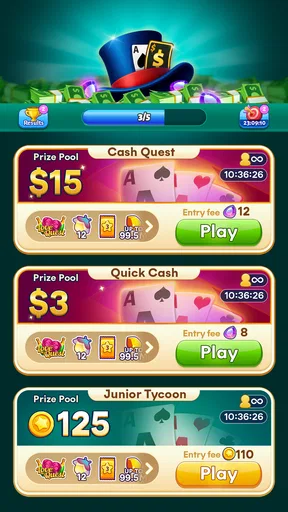
The promise of real rewards changes the emotional tone compared with a traditional solitaire game. Even when I am mainly playing for entertainment, the possibility of a meaningful payoff can make each hand feel more important. That can be exciting, especially for someone who finds ordinary solitaire too passive.
It also means I would not approach the game as a guaranteed way to earn money. Reward-focused games should be judged first as entertainment, with any potential reward treated as an extra rather than an expected income stream. That distinction protects the experience from becoming frustrating. If I play only because I feel I must win something, an ordinary loss becomes much harder to accept.
The mature age rating is another reason I would be careful about who uses it. I would not hand it to a child simply because solitaire itself is a familiar card game. The surrounding reward framing is aimed at adults, and parents should consider that context before installing it on a shared device.
There is also a spending consideration. The game is free to download, but in-app purchases range from $0.99 to $199.99 per item. That is a wide range, and it makes personal limits important. I recommend deciding in advance whether I am willing to spend anything at all, then keeping that decision separate from the excitement of a difficult hand or a tempting reward. A free entry point is useful, but it should not be confused with an entirely cost-free experience.
This is one of the clearest trade-offs in the design. The reward system gives the game more energy than a standard solitaire app, but it also asks me to manage my expectations and spending more carefully. Someone who wants a quiet, distraction-free card game may find that extra layer unnecessary.
A realistic everyday session shows where the game fits best
Imagine I am waiting for an appointment with about ten minutes to spare. I do not want to start a story-driven game because I may need to stop suddenly, and I do not want an online match that depends on another player. Solitaire Town Tycoon fits that moment well: I can begin immediately, make a few decisions, and put it down when my name is called.
In that situation, the progression layer helps because the session does not feel completely disposable. Even a short attempt can be part of a longer objective. However, I would avoid starting when I am already distracted or rushing. Solitaire rewards attention, and trying to play while answering messages can lead to careless moves that feel more irritating than relaxing.
It can also work as an evening wind-down if I enjoy light mental activity. The familiar format keeps the learning curve low, while the longer goals give me something to follow. Still, anyone who wants a purely meditative experience should compare it with a minimalist solitaire game first. The reward emphasis may make this title feel more active and commercially structured than a simple deck-and-table app.
How it compares with ordinary solitaire alternatives
A conventional solitaire app is usually the better choice when I want speed, simplicity, and no broader commitment. I can open it, play a hand, and leave without thinking about a town, a reward path, or a continuing objective. That simplicity has real value, especially for older devices, quiet offline-style play, or moments when I want the fewest possible distractions.
Solitaire Town Tycoon is more suitable when the basic card game alone is not enough to hold my attention. Its progression framing gives repeated hands a stronger sense of direction. Instead of asking only whether I won the current deal, it encourages me to think about how that result fits into the larger journey.
It is not a replacement for competitive multiplayer card games either. Those alternatives are built around opponents, rankings, and direct comparison. This game is a better match for solo players who want personal progress rather than a head-to-head contest. The absence of that competitive pressure can be relaxing, although players who need social interaction may find the experience less compelling.
Compared with a purely decorative card game, this one places more weight on achievement and rewards. That gives it a clearer retention hook, but it also makes the design less neutral. I would choose it when I want solitaire with an objective, not when I want the most stripped-down version of the card game possible.
Who should install it, and who should skip it
I would recommend it to adults who already enjoy solitaire and want more structure around each session. It is particularly well suited to players who like gradual progression, visible goals, and the possibility of rewards without needing a complex strategy system. The free starting point makes it easy to test whether the combination works for you before deciding whether it deserves regular play.
I would also suggest it to people who often play in short windows. The familiar rules make it quick to enter, and the ongoing journey gives those small sessions more meaning. It is a practical choice for waiting rooms, commutes as a passenger, or quiet breaks when I want something more engaging than scrolling.
I would skip it if I dislike reward-driven game design, feel uncomfortable with in-app purchase prompts, or want a completely calm solitaire table with no extra pressure. I would also look elsewhere if I need a deeply competitive card game, a social multiplayer experience, or a title suitable for children. In those cases, a standard solitaire app or a dedicated multiplayer card platform would be a better fit.
My progression verdict
Solitaire Town Tycoon succeeds because it understands that the basic solitaire rules are already strong, but familiar rules alone do not always sustain long-term interest. The early goals give new sessions direction, the progress signals make completed hands feel connected, and the challenge is enough to reward careful play without turning the game into a technical strategy exercise.
The retention design is also the main point I would ask readers to consider carefully. Rewards can make a routine card game feel more exciting, but they can encourage me to continue when I am no longer having fun. The free price is inviting, while the available purchases mean I should set boundaries before the reward chase becomes expensive. I see that as manageable, but only if I approach the game as entertainment rather than a dependable earning method.
The title has built a respectable audience, with an average rating of 4.6 from around six thousand ratings and more than one hundred thousand installs. Those figures suggest that the concept is connecting with a meaningful group of players, although they do not remove the need to decide whether its reward emphasis suits my own habits.
My final view is positive but specific: this is a good choice for an adult solitaire fan who wants a longer-term reason to play and enjoys measuring progress from one hand to the next. I would install it for the structured journey, keep sessions short, and treat rewards as a bonus rather than a promise. If what I really want is quiet, uncomplicated solitaire, the usual alternatives will be better. If I want familiar cards with more momentum, Solitaire Town Tycoon gives that simple format a worthwhile extra layer.
Pros
- Relaxing solitaire gameplay suitable for short sessions.
- Tycoon progression adds goals beyond simply winning card games.
- Easy-to-learn controls work well on phones and tablets.
- Offline play is useful when no internet connection is available.
- Frequent rewards help maintain a steady sense of progress.
Cons
- Ad interruptions can slow down the pace between rounds.
- Some upgrades may require considerable time or repeated play.
- Random card deals can make certain levels feel luck-dependent.
- The economy may encourage spending on boosts or extra resources.
- Limited gameplay variety may become repetitive for dedicated players.
FAQs for Solitaire Town Tycoon
What is Solitaire Town Tycoon about?
Solitaire Town Tycoon combines classic solitaire card gameplay with a light city-building and management system. You complete solitaire levels to earn rewards, then use those resources to expand and improve your town. As the town grows, you unlock new areas, decorations, upgrades, and progression goals, making it more than a traditional card game.
Is Solitaire Town Tycoon free to download and play?
Solitaire Town Tycoon can generally be downloaded and played for free, but it may include optional in-app purchases. These purchases can provide extra coins, boosters, lives, or other convenience items. The game is designed to offer regular progress without spending money, although players who want faster upgrades or fewer limitations may encounter promotional offers during play.
Does Solitaire Town Tycoon require an internet connection?
An internet connection may be needed for certain features, including advertisements, cloud synchronization, special events, updates, and in-app purchases. Some solitaire rounds or basic town activities may remain available when offline, but availability can vary by device and game version. Connecting regularly is recommended to ensure progress is saved and all features work correctly.
Is Solitaire Town Tycoon suitable for children?
The game is generally easy to understand because it uses familiar solitaire rules and simple town-building objectives. However, parents should review the age rating and device settings before allowing children to play, especially because the app may contain advertising, optional purchases, and social or online features. Younger players may also need guidance when managing rewards and spending.
What should I know about progression and in-game purchases?
Progression depends on successfully completing solitaire levels and using the rewards to develop your town. Some levels may become more challenging, while limited lives, boosters, timers, or resource requirements can slow advancement. Optional purchases may speed things up, but they are not always necessary. Players should check purchase settings and avoid spending more than intended.


